
Ron Davis’s retrospective at The Oakland Museum, Oakland, California, took place exactly 50 years ago. To commemorate, here is the best explanation in Ron’s own words of how he executed his renowned resin and fiberglass works, which were featured prominently in the retrospective.
This short statement was originally published in the catalog: Ronald Davis’ Paintings, 1962 – 1976. The catalog accompanied a retrospective exhibition at the Oakland Museum of Art, Special Gallery, July 13 – September 5, 1976
The most commonly asked question about my plastic paintings has been, “How do you make them?” My reply has been, “The same way one makes a fiberglass boat or car body.” In case you have never built a boat in your backyard, here is an attempt at a more technical explanation.
Eleven Colors, 53 1/4 x 137 inches (shaped), Moulded Polyester Resin and Fiberglass, Crab Series (PTG 0047)
In 1966 I began to substitute polyester resin plus pigments and dyes for traditional painting media. Fiberglass cloth and mat replaced canvas as reinforcement and support for the colored resin (paint). These plastic paintings were painted with a brush, face down, on a flat, waxed Formica mold. The mold itself was table height, and the small preliminary drawings I had made for these paintings were cartooned up to scale on the mold. The illusionary plane nearest the viewer was masked out with tape and painted first; the planes further away from the viewer were painted last. The rapid chemical heat-curing properties of resin (about thirty minutes) allowed me to apply layer behind layer of colored resin until the painting was completed. Layers of Fiberglas impregnated with resin were then laminated to the back of the painting, giving it a support, and a wood stretcher bar was attached to the painting. The completed painting was peeled from the waxed mold and polished. It was then that I viewed the painting for the first time!
Single Sawtooth, 1971, 37 x 102 inches (shaped), Flexible polyester resin and fiberglass, Cutout Series, (PTG 301)
On later plastic paintings, i.e. Eleven Colors, 1967, the wood was eliminated and instead the sides were molded onto the painting as one piece, and a backing sheet of resin and fiberglass was added for structural support. In 1970 I began to use a flexible type resin, i.e. Single Sawtooth, 1971, eliminated the sides entirely, and attached the painting directly to the wall with Velcro tape.
For [potential] health and aesthetic reasons I discontinued the use of resin and fiberglass in 1972.
— Ronald Davis 1976
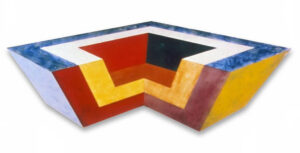
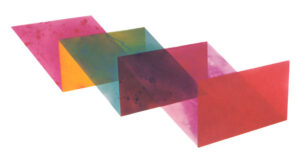
In my own work, specifically my illusionary polyester resin and fiberglass paintings, I didn’t get to look at the painting until it was done, after I pulled it off the mold, because I painted them from front to back, sight unseen — standing flat-footed.
In painting my 3D illusions, backwards, it forced a spatial depth that couldn’t be violated. I always started with a cartoon mockup of these resin paintings, a small line drawing on acetate or paper, sometimes colored-in with cel-vinyl acrylics. The cartoon mockup was enlarged (not projected) by marking the voxels of each shape’s edges onto the waxed mold that was built on a formica table, taping the edges, and applying layers of colored polyester resin (as paint). The last layer was fiberglass cloth laid directly behind the resin, analagous to canvas as a support.
Guston’s advice foreshadowed what I would come to learn from my own experience in the studio, which is that making a painting is very different from looking at a painting.
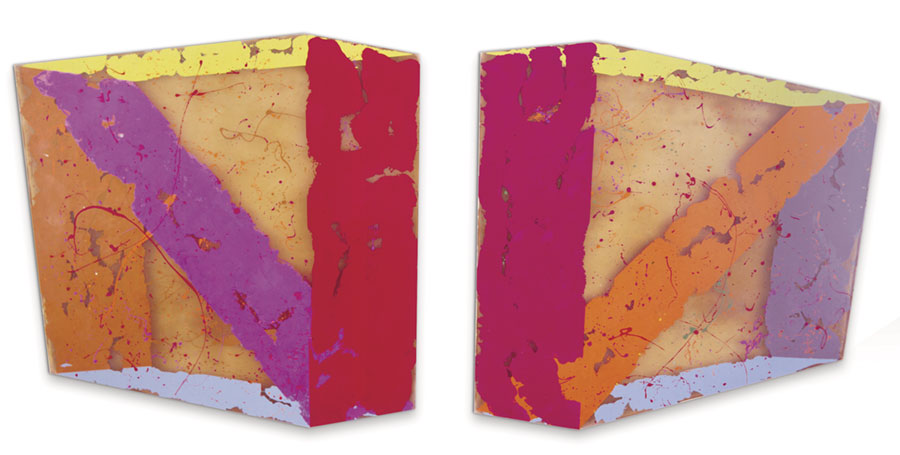
• Double Diagonal, 1969, 58 x 129 inches (two panels), Double Slab series. Molded pigmented polyester resin and fiberglass. PTG 0174
