
Ronald Davis: Recent Abstractions, 2001 – 2002 at Denver University
This statement was originally printed in the “one-sheet” accompanying the exhibition Ronald Davis: Recent Abstractions, 2001 – 2002, published by School of Art and History, Denver University, The Victoria H. Myhren Gallery, in Sept. 2002.
 When the illusion is lost, the art is hard to find. (1)
The recent paintings included in this exhibition were created between October 1, 2001 and August 2002. They are Modern, coming at the twilight of the Modern Era, or perhaps forty or fifty years after the actual ending of the Modern Era which began with the European Renaissance around the year 1500, and ended in the 1950s at the time I was embarking on my calling. Enlightenment has ended. “Post-Modenism?” I don’t think so. Historian John Lukacs refers to the “P-M” term as “this belated, confused and inaccurate designation.” (2)
I suggest that these works are seeking a new visual epistemology that is serious, moral, and spiritual, deviating from the self-indulgent, ironic, post-modern, and politically correct painting and non-painting (remember, “painting is dead”) or the scumbling of recent years, and place them in the tradition of the excellent abstract works of Abstract Expressionism (Pollock, Still, Newman, and Morris Lewis to name a few of the greats who continue to inspire me.) Constitutionally, I remain a geometrician and an expressionist.
These recent painting mark a departure from the major structural element (trademark) that I have pursued in the majority of my work over the past thirty-nine years; that being theoretical three-point vanishing point perspective illusions. In those works, I primarily employed three construction methods to draw or shape my paintings:
1) In the early years I relied on traditional drafting illustration methods to create drawings of depicted 3-D objects that were then cartooned up to the final scale of the painting. I should note that these depicted objects retained my commitment to abstraction; for me, a slab is just as abstract as a square.
2) In the seventies and eighties I drew my perspective grids full scale using snap lines, placing the vanishing points 40 to 60 feet apart.
3) Beginning in the early eighties, I increasingly relied on 3-D computer programs such as Presenter Pro, Renderman, Form•Z, or Cinema 4-D to sketch out the shapes and shadows, then projected them up in scale onto the painting. These methods served me well in solving the fundamental problem of painting: “What color and where to put it?” But the temporal gap between concept and preparation and the execution of a work led me to a studio crises. What I needed to do was reinvent a do-able concept of the “blank canvas.” I was compelled to discard my primary preoccupation of the last 39 years (the perspective grid) and seek a more direct means of visualization. This exhibition thus includes a watershed moment in my career: a going backward in order to move forward.
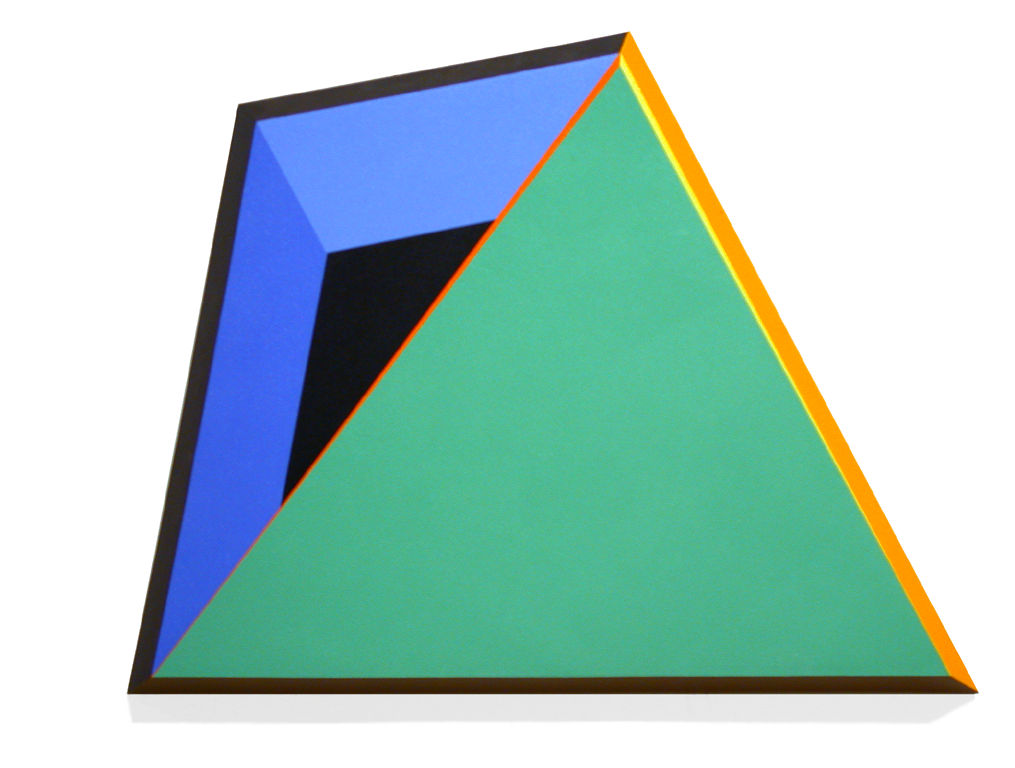 These recent abstractions evolve from crude pencil sketches, eschewing traditional perspective illusion and are drawn with the eye and the saw. Illusion remains, but these paintings are more optical and elusive – and, given looking time, move around a lot in subtle, ambiguous, and mysterious ways. They require greater focus. They are hard to do.
Note should be made of the reductive, Hard Edge nature of these abstractions. Over the years I have oscillated between the Hard Edge and the painterly. I do both loose and precise with facility. However, in these complicated times a need for clarity seems paramount. I have found that color contrast and interaction trump drips, splatters, scumbles, brush-work, and other non-art content sludge as the means to true expression of the soul and intellect. Indeed, the chary binding of these bipolar opposites are at those extremes where opposites simultaneously meet and transcend sign-making. Unknown archetypes of heart, head and crotch are discovered and revealed.
— Ronald Davis, July 2002
(1) Quote from a family drawing
(2) Lukacs, John, At the End of an Age, Yale University Press, New Haven
Paintings: Yellow Hinge, 2001, top left; Green Triangle Overlay, 2001, bottom right.
Ronald Davis: Recent Abstractions, 2001 – 2002 at Denver University
This statement was originally printed in the “one-sheet” accompanying the exhibition Ronald Davis: Recent Abstractions, 2001 – 2002, published by School of Art and History, Denver University, The Victoria H. Myhren Gallery, in Sept. 2002.
When the illusion is lost, the art is hard to find. (1)
The recent paintings included in this exhibition were created between October 1, 2001 and August 2002. They are Modern, coming at the twilight of the Modern Era, or perhaps forty or fifty years after the actual ending of the Modern Era which began with the European Renaissance around the year 1500, and ended in the 1950s at the time I was embarking on my calling. Enlightenment has ended. “Post-Modenism?” I don’t think so. Historian John Lukacs refers to the “P-M” term as “this belated, confused and inaccurate designation.” (2)
I suggest that these works are seeking a new visual epistemology that is serious, moral, and spiritual, deviating from the self-indulgent, ironic, post-modern, and politically correct painting and non-painting (remember, “painting is dead”) or the scumbling of recent years, and place them in the tradition of the excellent abstract works of Abstract Expressionism (Pollock, Still, Newman, and Morris Lewis to name a few of the greats who continue to inspire me.) Constitutionally, I remain a geometrician and an expressionist.
These recent painting mark a departure from the major structural element (trademark) that I have pursued in the majority of my work over the past thirty-nine years; that being theoretical three-point vanishing point perspective illusions. In those works, I primarily employed three construction methods to draw or shape my paintings:
1) In the early years I relied on traditional drafting illustration methods to create drawings of depicted 3-D objects that were then cartooned up to the final scale of the painting. I should note that these depicted objects retained my commitment to abstraction; for me, a slab is just as abstract as a square.
2) In the seventies and eighties I drew my perspective grids full scale using snap lines, placing the vanishing points 40 to 60 feet apart.
3) Beginning in the early eighties, I increasingly relied on 3-D computer programs such as Presenter Pro, Renderman, Form•Z, or Cinema 4-D to sketch out the shapes and shadows, then projected them up in scale onto the painting. These methods served me well in solving the fundamental problem of painting: “What color and where to put it?” But the temporal gap between concept and preparation and the execution of a work led me to a studio crises. What I needed to do was reinvent a do-able concept of the “blank canvas.” I was compelled to discard my primary preoccupation of the last 39 years (the perspective grid) and seek a more direct means of visualization. This exhibition thus includes a watershed moment in my career: a going backward in order to move forward.
These recent abstractions evolve from crude pencil sketches, eschewing traditional perspective illusion and are drawn with the eye and the saw. Illusion remains, but these paintings are more optical and elusive – and, given looking time, move around a lot in subtle, ambiguous, and mysterious ways. They require greater focus. They are hard to do.
Note should be made of the reductive, Hard Edge nature of these abstractions. Over the years I have oscillated between the Hard Edge and the painterly. I do both loose and precise with facility. However, in these complicated times a need for clarity seems paramount. I have found that color contrast and interaction trump drips, splatters, scumbles, brush-work, and other non-art content sludge as the means to true expression of the soul and intellect. Indeed, the chary binding of these bipolar opposites are at those extremes where opposites simultaneously meet and transcend sign-making. Unknown archetypes of heart, head and crotch are discovered and revealed.
— Ronald Davis, July 2002
(1) Quote from a family drawing
(2) Lukacs, John, At the End of an Age, Yale University Press, New Haven